
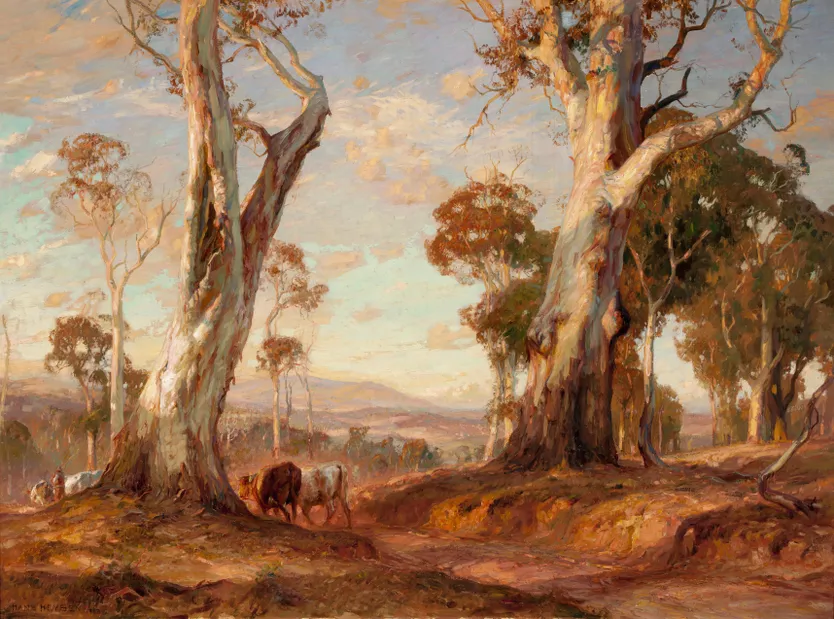
The Landscape: Looking out
As a genre of art, landscape is the depiction of natural scenery. It wasn’t until the late sixteenth and early seventeenth centuries that landscapes in Western art were released from the backgrounds of history paintings or portraits to become a subject of art in its own right.
Since then, the depiction of landscape has encompassed a wide-ranging set of artistic intentions. These vary from an appreciation of the beauty of nature to a highly constructed record of power and authority over place. During the Renaissance, Dutch and Flemish painters captured the detail and irregularity of nature with renowned accuracy. In the early to mid-nineteenth century, romantic pastoral views were largely a reaction to the increasing industrialisation and modernisation of society. At the turn of the twentieth century the impressionists took their painting practice outdoors, expanding the genre to include both natural and urban scenes.

Tips and ideas for teaching landscape in Visual Art
- Go outside, take your sketchbook and pencil, and sketch what you see. Try to capture the moment; many artists try to capture the moment rather than perfect realism. Draw buildings, cars, roads, trees, fences, and lampposts.
- Explore the theme of light at different times of the day. Take photographs of the same scene at morning, midday, sunset, and night, and compare the light and how it changes. Study the work of Claude Monet, who made repeated studies of the same subject at different times of the day.
- Draw the view through a window. What can you see? Are there buildings, fields, gardens, or playgrounds? Draw the window frame and what is outside. Look at the work of Henri Matisse and his paintings of views through windows. Consider using unrealistic colours inspired by Matisse's work.
- Draw the journey to and from school. Where do you start? Which roads do you take? What do you see? Record your journey as a line and images drawn from memory.
- Think of a landscape you have seen somewhere you would like to go again, such as the beach, the park, the hills, a forest, a mountain, or a reserve. How could you draw this landscape?
The invention and increased use of photography in the modern era encouraged artists to explore and experiment, as they were no longer needed to depict notable people, places or events with incredible accuracy. If photographic depictions surpassed the need for artists, what is the role of the artist in painting landscapes or people in the modern era, and also today?
A painting sometimes consists of a foreground, middle ground and background. What do you think is the function of these planes? Draw over photocopies of your favourite landscape painting in AGSA's collection to identify the foreground, middle ground and background. Repeat this for a few of more paintings with different subject matter. Was the composition constructed the same each time? Where does the artist place their subject matter? What is consistent about their compositions?
Take a series of photographs of the same scene at ten different times during one particular day. Examine the light and colour you have captured at each interval. Which time of the day did you prefer? Compare your images with other members of your class.

Trent Parke, born Newcastle, New South Wales 1971, 365 sunsets, Adelaide, 2010-11, Adelaide, 365 pigment prints; Gift of Macquarie Group through the Art Gallery of South Australia Contemporary Collectors Trent Parke Appeal 2015, Art Gallery of South Australia, Adelaide, © Trent Parke, courtesy of Hugo Michell Gallery, Adelaide, Michael Reid Gallery & Magnum Photos.
- Explore your local environment and make a series of sketches from different viewpoints. Back in the classroom create three works of art of the same scene using layered tones of chalk pastel on different textured papers. Which surface did you prefer using and why?
- Find a work of art that you think was painted in winter and one that was painted in summer. What are the winter and summer colour palettes where you live? Visit a paint store and select paint swatches that best represent two opposing seasons where you live. Using these colours create a work of art of that captures the essence of your favourite season.
- During a lunch time at your school complete an en plein air painting or pastel drawing of students playing and interacting with each other. How will you capture the figures being merged with their environment and the atmosphere or energy of this moment?
- Take a nature walk with your class. Look closely at your surroundings and focus on the small details, such as the colour of the plants and trees or the details in the bark or leaves, or the shadows created on the ground. Draw these observations in your sketchbook.
Science as a Human Endeavour - Development across disciplines
The collapsible screw top oil tube meant that Impressionist painters could now paint outside with ease, thus this technology influenced the type of work artists were able to undertake.
- What new technologies have changed the way artists are working today?
- Investigate an artist and discuss how technology has influenced the type of work they are producing. How has this technique changed over time?
- Besides being used for artistic purposes, what other role does this technological advancement have in society? For example, consider the invention of plastics and development of synthetic silicones. TIP: You might like to start with investigating Marc Newson’s Lockheed Lounge in the Gallery’s collection.


