
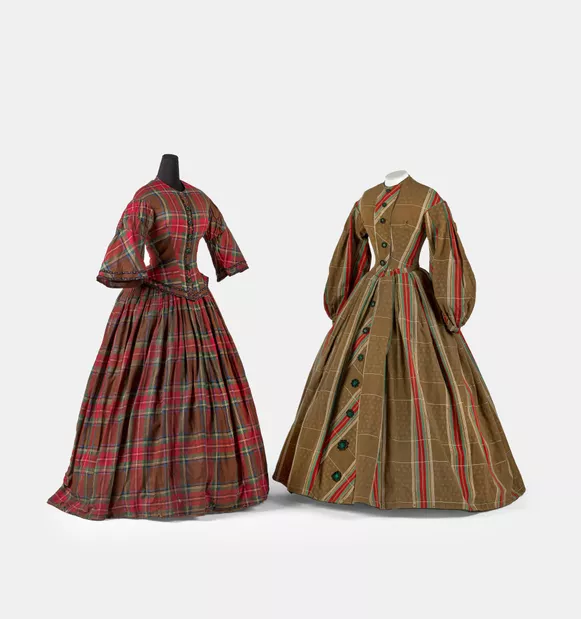
Day Dress, worn by Mrs Josephine Geyer
Who was Mrs Josephine Geyer?
Mrs Geyer was born Josephine Bunn in 1830 in England, arriving in Adelaide in the 1840s and, by 1850, her father, Francis Bunn, was the publican of the Golden Fleece hotel on Currie Street. Adelaide was already a bustling city: money was flowing back from the Victorian goldfields, train lines were being built to Port Adelaide and to Gawler to support agriculture, and the Melbourne to Adelaide telegraph line opened in 1858. There was support for the arts too, with the South Australian Institute being established in 1856. The Institute held regular exhibitions and advocated for a permanent state gallery collection.
Josephine married Frederick Geyer of Adelaide in 1857. Frederick and his family were likely among those who had left regions of Prussia (now part of Germany) as a result of religious persecution. Frederick, a chemist, was proprietor of Geyer & Co, on Hindley Street. Josephine and Frederick had two children, a boy and a girl, but just five years after their marriage Fredrick became ill with influenza and died, soon followed by their daughter Eva. After Frederick’s death Josephine managed the chemist business.
This dress was donated in 1937 by Miss Gertrude Madigan, following the centenary of Colonisation celebrations in 1936. At the time of the donation, it was recorded that Mrs Geyer was Gertrude’s great-aunt.
Day Dress Details
Josephine’s striking day dress is made from a heavy corded cotton, wool and silk blend. The fabric features an unusual design, with its base colour of tan and intervals of cream, green, yellow and red stripes intersecting with bands of a delicate arrow-like pattern. Although the fabric is heavy and hard-wearing, the silk threads used to create the arrow patterns shimmer in the light.
The gown was made by a skilled dressmaker and, during its making, the fabric was carefully lined up to ensure that the repeating pattern is used to the best effect. The long, full sleeves, dropped shoulders, slightly pointed waistline and bell-shaped skirt are characteristic of dress designs of this period. The dress would have been worn over a corset and hooped skirt. Advances in manufacturing during the first half of the nineteenth century meant that corsets had become more flexible, while hooped skirts were lighter and cheaper, freeing women from the heavy underskirts worn earlier in the century.
This gown has hook-and-eye closures on the front of the bodice and also features decorative buttons at the centre front, from neck to floor, these gradually increasing in size. The green thread used on these buttons matches that of a tartan dress also worn by Mrs Geyer, which is held in AGSA’s collection.
As was often the case in this period, the dress has no maker’s label, so it’s impossible to know for sure who made it or where the fabric was produced, although it is known that Adelaide had numerous drapers, including Miller Anderson, which was located almost next door to Geyer and Co. on Hindley Street. It is likely then that this dress was made in Adelaide from imported material.
It is estimated, based on the shape of the dress and the combination of machine and hand stitching, that this gown was made and worn in the 1860s. This suggested date aligns with similar gowns found in period photographs and fashion plates, as well as in painted portraits.
Text by Ingrid Goetz is the Vernon-Roberts Assistant Curator of Decorative Arts & Design at AGSA, featured in AGSA Magazine
- Write a diary entry, monologue or short historical fiction piece from the perspective of the Mrs Josephine Geyer.
- Take a walk to Gallery 2 to look at the Barossa Wall. This display in the Gallery reminds us of the importance of early German migration to South Australia and impact of German migrants on our social, visual and craft history. Look closely at the wall and consider:
What clues suggest the cultural backgrounds of the people who made or owned these objects?
Which materials, techniques or decorative motifs stand out to you?
What aspects of everyday life might these objects reveal?
How might these objects have helped migrants maintain connections to their homeland?
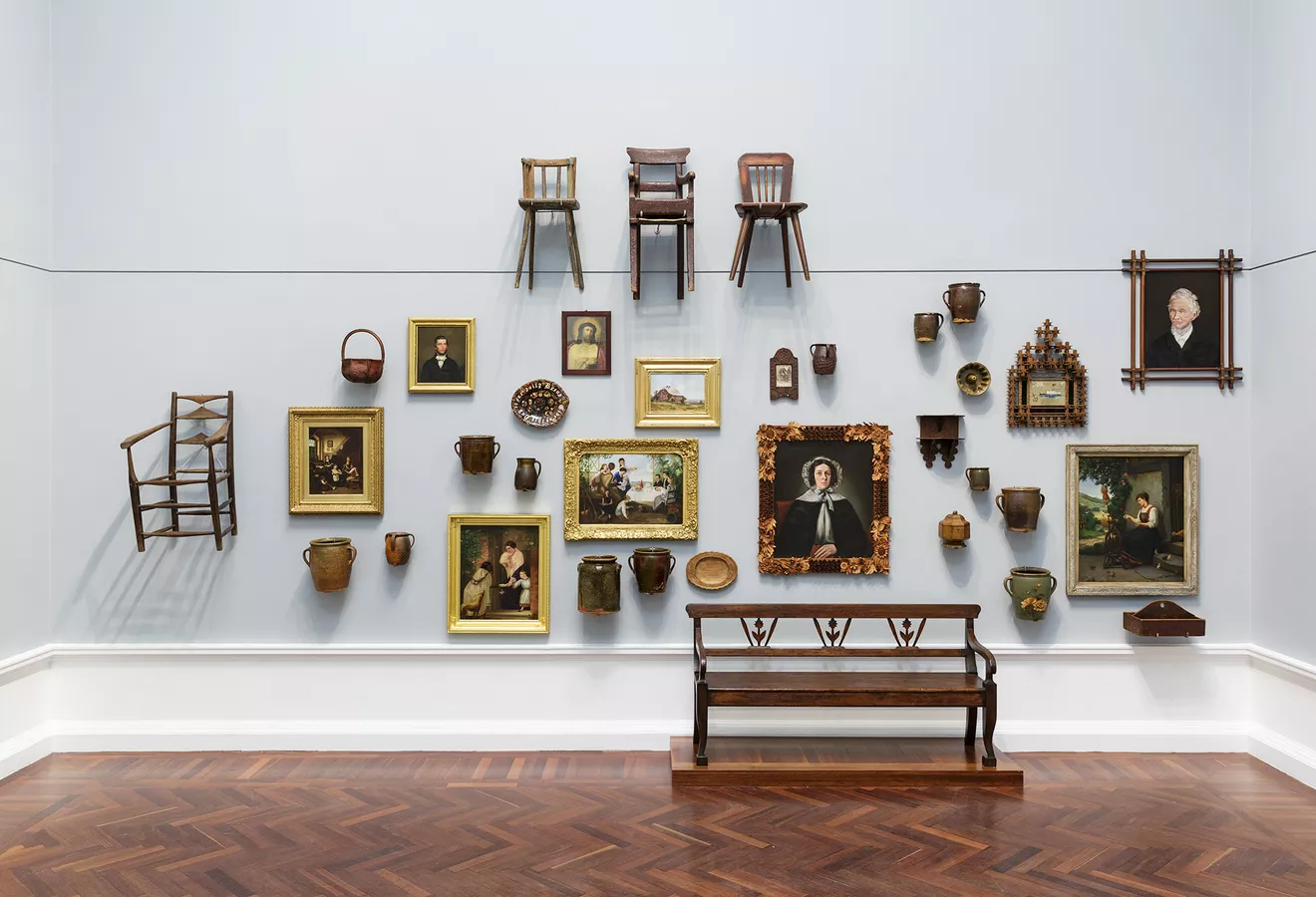
Installation view: Elder Wing of Australian Art, Art Gallery of South Australia, Adelaide, 2019. Photo: Saul Steed
Imagine your family was moving to a new country and could take only one object that represents your identity, culture or traditions. Draw or describe your chosen object and explain:
- Why you chose it?
- What story does it tell about you or your community?
- What might future historians learn from it?
Day Dress, worn by Mrs Josephine Geyer, describes what the garment is and who wore it. But sometimes artists or makers might create interesting titles for works of art. Create a new title for this garment.
Then and now
Imagine Josephine Geyer lived in Adelaide today. Design a contemporary version of her dress that reflects modern lifestyles while retaining at least three features from the original garment.
Label your design and explain:
- Which historical elements you retained
- What changes you made
- Why these changes suit contemporary life
We know that Josephine managed her husband’s business Geyer & Co, on Hindley Street and her father, Francis Bunn, was the publican of the Golden Fleece hotel on Currie Street.
- Locate historical images of Adelaide, particularly these two places.
- Use Google Maps to find what these places look like today.
Write a letter to Josephine describing how things have changed in Adelaide since 1860s.
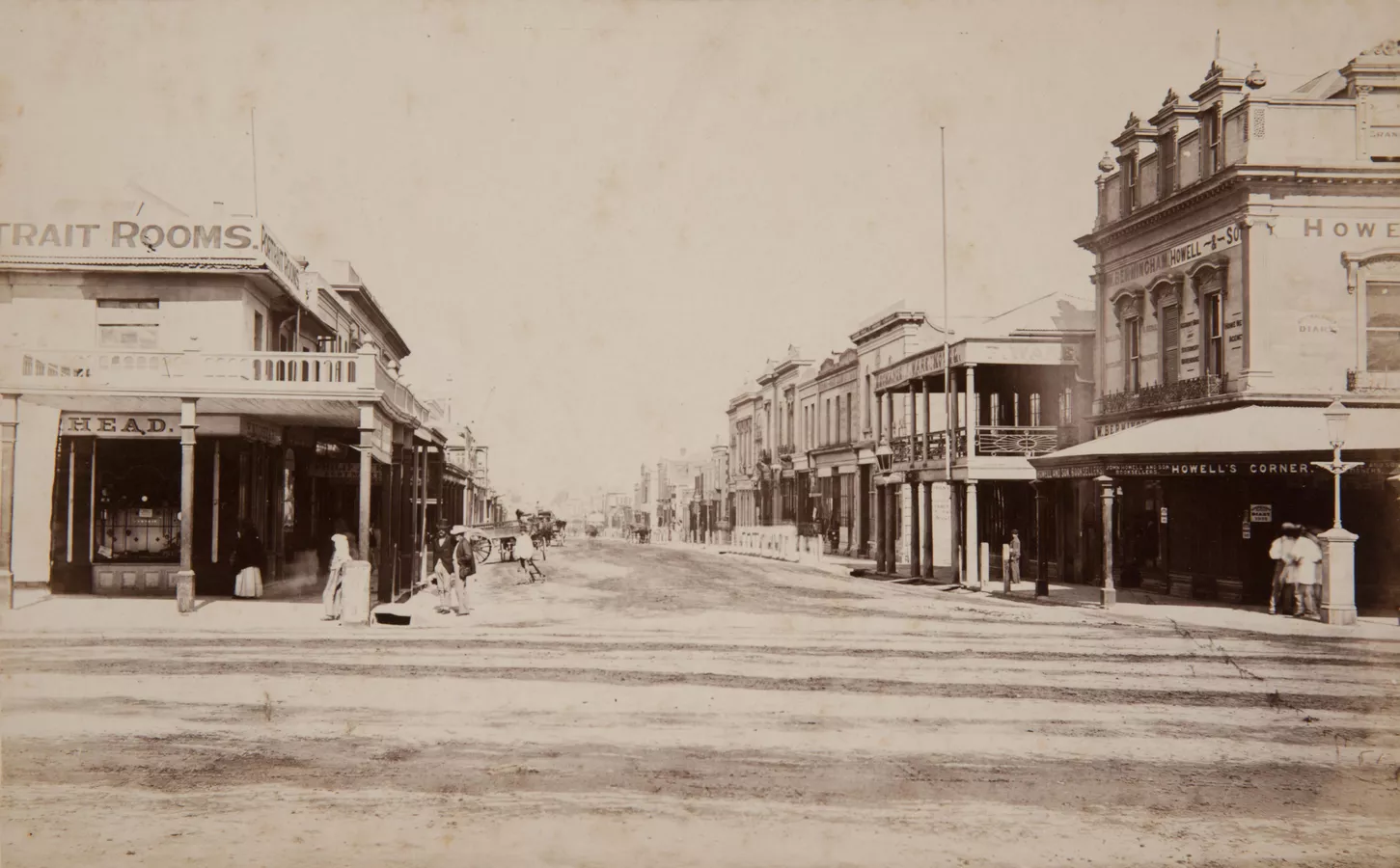
attributed to E G Tims, 1843/44, after 1882, Hindley St, c.1873, Adelaide, albumen-silver photograph , 12.5 x 19.9 cm (image); Gift of Michael Abbott 2003, Art Gallery of South Australia, Adelaide.
Many contemporary garments include labels that tell us where an item was made, who designed it, what materials were used and how to care for it. Historical garments often do not include this information.
Josephine Geyer's dress has no maker's label, making it difficult for historians to know exactly who created it or where the fabric originated. Instead, researchers use clues such as style, materials, stitching techniques and historical photographs to learn more about the garment.
- Create two lists for Day dress: Information a label could tell us and Clues found in the dress. What information is still missing?
- Take a look at a variety of labels found on your clothing at home, make a list of the information that labels provide. Now think about what information is missing. This garment might be one you own, so you know the history of it. Image this garment was to be discovered as a historical object in 100 years time. Write a small paragraph to accompany the garment that might tell a historian something about you and the item of clothing that they couldn’t discover just by looking at it or reading the label.
Compare the experiences of nineteenth-century German migrants with migration stories in South Australia today.
What similarities and differences can you identify in:
- Reasons for migration
- Maintaining cultural traditions
- Building community connections
- Contributions to South Australian society
How do objects help us understand the experiences and contributions of migrant communities throughout history?